
EUROPEAN UNION INSTITUTION · BRAND STRATEGY AND IDENTITY
Turning research and participation into one coherent ESMA brand system.
ESMA wanted a corporate identity fit for an influential European regulator entering its second decade. Working with its communications team, we translated staff and stakeholder insight into a brand strategy, a new visual identity and a practical system spanning institutional publications, digital channels, events and everyday communication tools.
At a glance
- Client
- European Securities and Markets Authority (ESMA)
- Context
- Independent European Union financial markets regulator and supervisor
- Challenge
- Align ESMA’s corporate identity with its institutional maturity, strategic role and increasingly digital presence
- Contribution
- Research framework, survey analysis, facilitated workshop, brand strategy, visual identity, cross-channel applications and guidelines
- Visible result
- A public 93-page Visual Identity Guidelines document that makes the strategy usable across internal and external communication
The challenge
A mature European authority needed more than a visual refresh.
ESMA had grown in profile, mandate and influence. Its identity needed to reflect that maturity while remaining recognisably European, credible as a regulator and accessible to the people who use its information.
The system also had to perform in very different contexts: formal regulatory documents, public reports, consultations, data visualisation, digital communication, social media, conferences, presentations and internal templates. The task was therefore to connect institutional strategy, stakeholder perception and day-to-day usability — not simply to redesign a logo.
The approach
1. Build an evidence base before making design decisions
Two online surveys gathered internal and external perspectives. The responses created an evidence base for understanding how the organisation was perceived, where the existing identity helped or hindered communication, and what a renewed brand needed to express.
2. Turn findings into shared strategic choices
In a video workshop with ESMA’s communications team, we examined the survey findings together and used them to define the brand strategy that would guide the rebranding. This kept the strategy grounded in ESMA’s mandate, expertise and organisational reality while creating a shared frame for creative decisions.
3. Translate the strategy into a distinctive visual system
The approved direction was developed into a coherent identity combining logo, colour, typography, imagery, iconography and layout principles. Each element had a role: strengthen recognition, clarify information and make the identity adaptable across formal and more engaging communication formats.
4. Make the identity operational
The work was consolidated in ESMA’s 93-page Visual Identity Guidelines. Rather than stopping at visual principles, the guide shows how the system works across documents, reports, consultations, presentations, social media, events, signage and other practical applications.
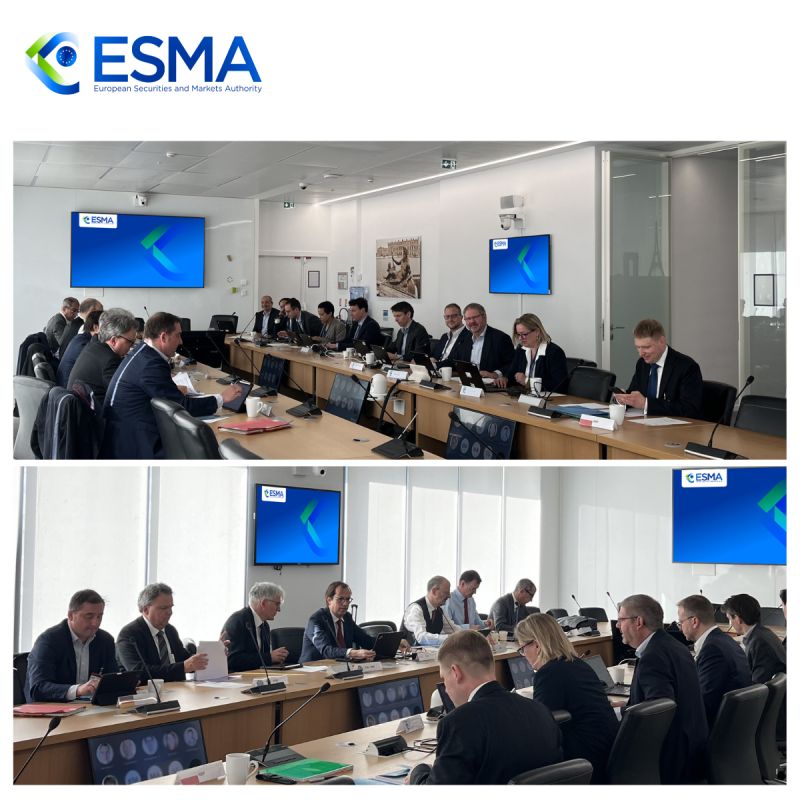
From brand strategy to a working system
The published guidelines connect strategic foundations with concrete usage.
- 01
Brand essence, vision, mission and organisational behaviours.
- 02
Logo architecture, colours, gradients, typography, imagery and iconography.
- 03
A modern digital brand for presentations, social media and screen-based communication.
- 04
Consistent systems for reports, consultations, newsletters and institutional documents.
- 05
Event and physical applications, from banners and badges to signage.
- 06
Clear rules that staff and external partners can apply in daily work.
The impact
One identity, designed to carry institutional meaning across many contexts.
The result is a shared communication system rather than a collection of isolated assets. ESMA can express the same institutional character across regulatory, corporate, digital and event communication while giving users clear guidance for consistent implementation.
The case also demonstrates a principle central to our work: participation is most valuable when it leads to explicit criteria. Research and workshops created the strategic foundation; the identity and guidelines made that foundation visible and usable.

Does your identity still reflect the organisation you have become?
Bring us the gap between the organisation you have become and the identity people use today. A first conversation can clarify whether the useful starting point is research, alignment, a workshop or a defined branding assignment.
Continue