04 / 09 · The Workshop Advantage
Part 4Develop campaigns and creative directions
Establish a strategic starting point
Strategic work can begin with an organised view of the situation. The author's experience includes a workshop for an international consortium that used SWOT and PESTE to establish a starting assessment and explore potential strategic directions. Here, PESTE refers to political, economic, social, technological and environmental factors.
These analytical structures provide places to organise observations. Their usefulness depends on the quality of the evidence, the perspectives represented and the interpretation of what emerges. Listing strengths or environmental changes gives the group material to examine. The next task is to identify which connections matter for the organisation and what choices they suggest.
The facilitator can ask participants to explain the basis of an observation, distinguish a current condition from a possible future development and examine how one factor changes another. A claimed strength may be relevant to one audience and less useful to another. A potential threat may create a communication need, a wider strategic question or both.
The expected result can be a shared assessment and a set of directions requiring further examination. The organisation retains responsibility for adopting its strategy. Where the agency helps develop that strategy, the work is done with the organisation and remains the organisation's.
Build campaign foundations before selecting outputs
A campaign workshop can bring purpose, audiences, evidence and participation into one discussion. It needs to establish what communication is expected to contribute, whose understanding or action matters and which resources or relationships can support the effort.
The author's experience includes developing a communication strategy with the team and member representatives of a European association. Other workshops prepared a campaign running for a year for an association whose reputation was being challenged by NGOs, and a communication strategy and campaign in public health in a context of powerful lobbying interests.
Assignments of this kind require organisational expertise, communication judgement and stakeholder perspectives to inform the campaign's direction. The workshop provides a structured opportunity to bring those contributions together before deciding how to act.
For a contested issue, the quality of the starting analysis matters particularly. A workshop should give the group space to examine the substance of criticism, the interests involved, the evidence available and the questions audiences are likely to ask. This can reveal a need for clearer explanation, additional evidence, a different emphasis or a response extending beyond communication.
A campaign foundation can then connect the objective to messages, credible sources, roles and a sequence of actions. The degree of detail should match the assignment. A workshop may establish the architecture for a programme while leaving detailed creative development, production planning or formal approvals to subsequent work.
Define a creative problem people can work on
Creative workshops need enough direction for participants to examine meaningful alternatives. An annual report, anniversary publication, event or conference comes with a subject and format, but still requires choices about its purpose and the experience it should create.
For an annual report, the group might ask which developments explain the organisation's priorities and what readers need to understand beyond a record of activity. For an anniversary publication, the question may concern how the organisation's history should inform its future role. For an event or conference, it may concern the central question around which contributions, content and participant experience should connect.
Such questions reveal the specific creative challenge inside a familiar deliverable. Defining that challenge gives participants a useful starting point and gives the creative team a basis for subsequent proposals.
The workshop should also make relevant constraints visible. Audience expectations, evidence, available material, production conditions, language requirements and approval responsibilities can all affect what is possible. Creative exploration becomes more useful when participants understand the conditions in which an idea will have to work.
Explore alternatives before settling a direction
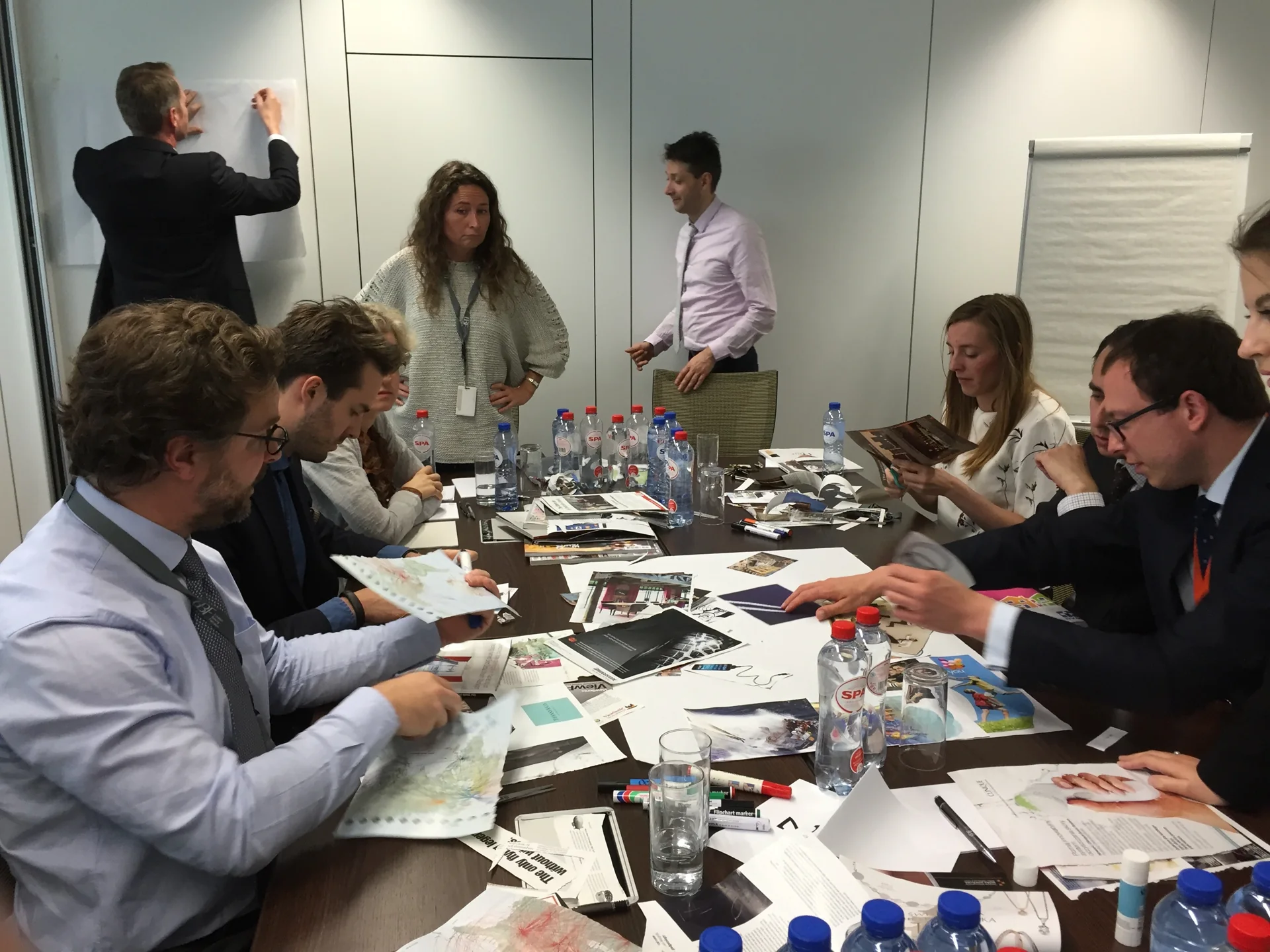
A group benefits from a deliberate opportunity to develop different answers. Participants might explore alternative narratives, compare several ways into the subject, examine contrasting references or sketch possible structures. The method should fit their knowledge and the purpose of the assignment.
The Design Council's Double Diamond distinguishes discovery, definition, development and delivery, combining exploration with the narrowing and testing of possibilities. It is a broader design process. For workshop planning, its relevant lesson is to give understanding the problem and developing alternatives their own space before committing to a solution.[4]
The facilitator should be clear about the status of exploratory material. A reference image can illustrate an intended quality without becoming a proposed design. A rough structure can test an idea without fixing the finished publication. This allows people to discuss substance before craft and production make a direction appear more settled than it is.
Evaluation needs criteria linked to the brief. Ask how each direction serves the audience, supports the intended message, uses the available evidence and fits the organisation. Personal preference can contribute information, but the group needs to explain how a preference relates to the communication task.
Turn creative discussion into a usable direction
A useful creative direction explains the idea that should guide development and why it is appropriate. Depending on the project, the report may record a central narrative, desired qualities, content priorities, references, structural principles or criteria for evaluating proposals.
It should also identify what remains to be developed. A workshop can establish a direction from which specialists produce concepts or prototypes. Those proposals may require further testing, refinement and approval. Preserving this sequence helps the client and creative team understand what has been decided and where creative work remains open.
For the communication manager, this can provide a clearer way to brief and review the project. Contributors can see how their input relates to the direction, while designers and editors have a common basis for making proposals. Subsequent disagreement can be examined against the agreed question and criteria.
Structure websites and important presentations
Workshops can also serve a focused project question. The author's examples include identifying the structure of a new website for a European organisation and preparing an important general assembly presentation by a secretary general.
For a website, collective work can organise what the organisation knows about audiences, content and priorities. The group can develop a proposed information structure and identify gaps in its knowledge. Actual user research and testing can then examine assumptions about navigation and comprehension where needed.
For an important presentation, the work can clarify what the audience needs to understand, the main argument, supporting evidence and the sequence through which the speaker will develop it. A workshop can help colleagues compare the messages competing for limited attention and give the presentation a coherent direction.
The value of these focused assignments is their proportion. The working question may concern one structure, one narrative or one intervention. The process should be sufficient to move that question forward without making the surrounding assignment larger than the client needs.
Source for Part 4
[4] Design Council, The Double Diamond. Design process framework used for the stated distinction between exploration, definition, development and testing. Read source
Related agency work: Zhaga strategic workshop. Explore strategic workshops.