09 / 09 · The Workshop Advantage
Practical extension 2The Workshop Capability Test
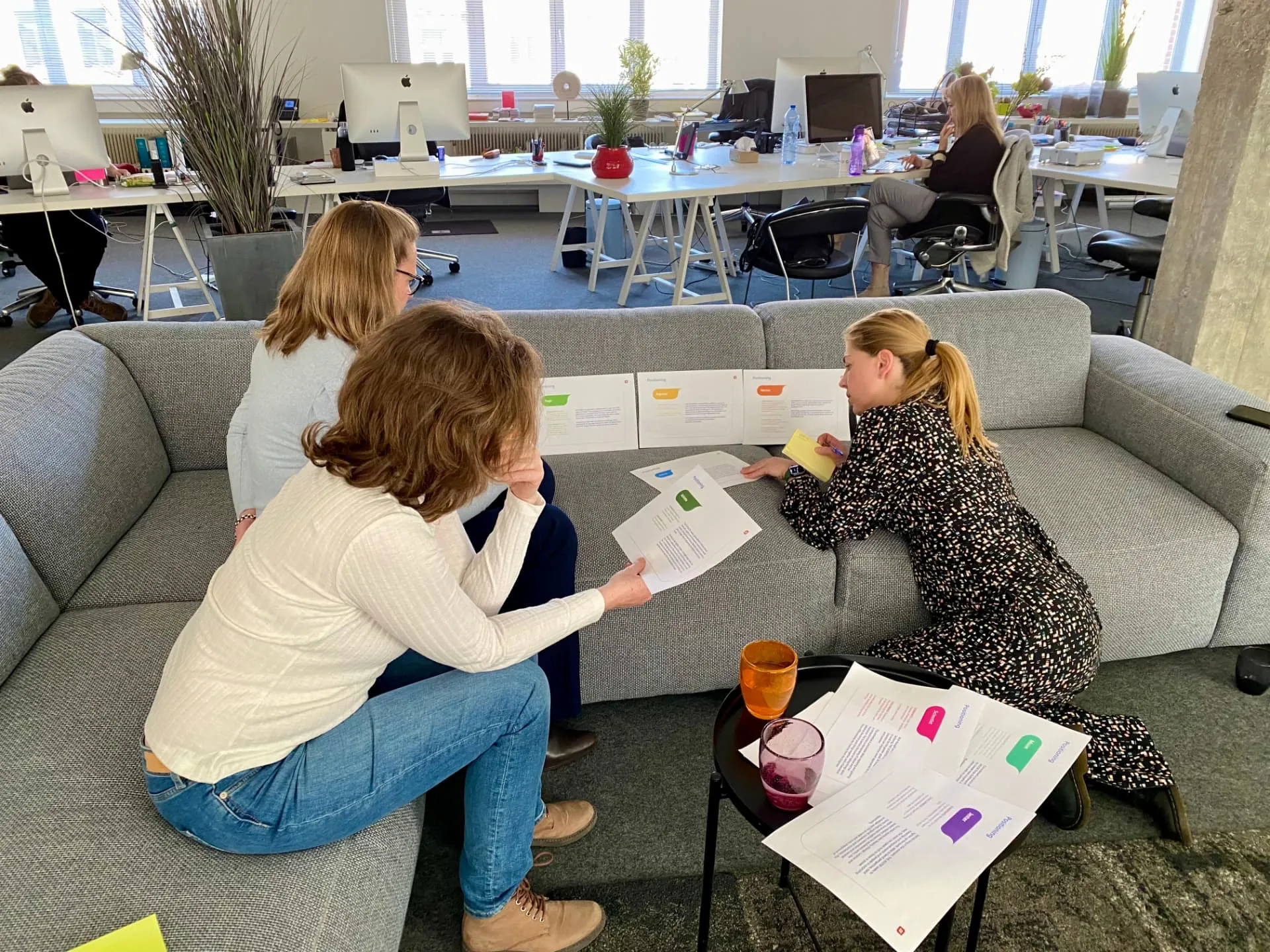
Twelve questions for a management conversation
Use this self-assessment with colleagues who commission, prepare, facilitate or use workshops. Refer to recent examples relevant to your organisation. Answer individually before comparing views so that differences in experience remain visible.
The test follows the six dimensions of the Workshop Capability Model. It is a discussion aid created for this publication. The scores and bands are illustrative editorial conventions, not validated benchmarks, predictions of effectiveness or comparisons with other organisations.
Score each question from zero to two.
- Yes scores 2. The practice is explicit and can be demonstrated in relevant recent work.
- Partly scores 1. Useful elements exist, but practice is incomplete or inconsistent.
- No scores 0. The practice is absent or the team cannot currently demonstrate it. Flag missing evidence for discussion.
The maximum score is 24. Each dimension has a maximum of four. Record the example supporting each answer; a score without an example gives the management conversation less to work with.
Dimension 1 Purpose and scope
Question 1 Can we explain why this question needs collective work
Before choosing a workshop, can the organisation identify a concrete question and explain how interaction between the relevant people could help answer it? Does it consider whether a focused conversation, research, explanation or specialist assignment would better fit the need?
Why it matters: the usefulness of participation depends on the work it can influence. A clear reason for bringing people together gives the design a practical starting point.
Evidence to look for: a briefing that explains the question, the contributors needed and the reason for using a workshop.
Question 2 Is the expected result defined at the right level
Does the brief say what the workshop should clarify, develop, practise or recommend? Are fixed boundaries and later approvals clear? Can the team distinguish an exploratory direction from a decision or finished deliverable?
Why it matters: the expected result shapes preparation and allows the findings to be described accurately afterwards.
Evidence to look for: an agreed description of the result, its status and its intended use.
Dimension 2 Evidence and preparation
Question 3 Does existing information inform the workshop
Are relevant documents and perspectives reviewed before designing the session? Does the team distinguish evidence, assumptions and gaps that could affect the work? Is any additional research proportionate to the question?
Why it matters: preparation allows the group to work from an informed starting point and gives uncertainty an explicit place in the discussion.
Evidence to look for: a document review, evidence pack or preparation note connected to the working question.
Question 4 Is the agenda refined for the actual client and group
Is the proposed agenda discussed with the client or internal sponsor? Are activities prepared for the participants and the expected result? Is the contact's level of involvement in preparation agreed?
Why it matters: bespoke design becomes visible in the relationship between the question, sequence, material and people taking part.
Evidence to look for: a refined agenda, prepared exercises and clear preparation responsibilities.
Dimension 3 Participation and authority
Question 5 Are the relevant perspectives able to contribute
Does the participant group include the knowledge and responsibilities needed for the question? Are member and partner perspectives represented where relevant? Do language, accessibility and working methods allow those people to take part meaningfully?
Why it matters: inviting a broad group does not itself establish that the contributions needed for the assignment will be available.
Evidence to look for: a participant rationale and practical arrangements connected to contribution needs.
Question 6 Are decision rights and representation explicit
Do participants know whether they are offering expertise, representing an organisation, recommending a direction or making a choice within delegated authority? Is the route for any later approval understood?
Why it matters: a useful workshop outcome can be weakened or misrepresented when attendance is mistaken for authority to commit an organisation.
Evidence to look for: stated roles, sponsor boundaries and a clear route for recommendations or decisions.
Dimension 4 Facilitation and development
Question 7 Do the activities serve the work required
Can the team explain why each main activity is included? Does the sequence give participants an appropriate way to develop observations, compare perspectives, explore alternatives or practise a method? Can it be adjusted when an important finding changes the work?
Why it matters: activities need a clear relationship with the purpose and the material required for the report.
Evidence to look for: an agenda with explicit purposes, usable instructions and examples of appropriate adaptation.
Question 8 Can the group consolidate without losing important differences
Are observations and alternatives examined against relevant evidence or criteria? Are professional recommendations identifiable? Does the capture method preserve the reasoning and qualifications needed to understand the main findings?
Why it matters: useful synthesis helps a reader understand the substance of the work while retaining differences that could affect its use.
Evidence to look for: captured comparisons, criteria, reasoning and an accurate closing account of what remains open.
Dimension 5 Reporting and subsequent use
Question 9 Does a written report preserve the findings and their status
Is there a report proportionate to the assignment? Does it distinguish established information, interpretations, options, recommendations, decisions and open points where relevant? Could a colleague who was absent use it without guessing what was actually agreed?
Why it matters: the written account allows the workshop's substance to remain available beyond the session.
Evidence to look for: a report that states the working question, main findings, qualifications and appropriate next steps.
Question 10 Is the next use of the report clear
Does the organisation know who will use the report and for what purpose? Where appropriate, are responsibility, approval routes and dependencies identified? Is any additional implementation support explicitly scoped?
Why it matters: findings need a route into the work, decision or learning process they were intended to support.
Evidence to look for: an identified user, an agreed next stage or examples of the report informing subsequent work.
Dimension 6 Learning and continuity
Question 11 Can participants apply the methods they are expected to learn
Where capability development is part of the purpose, do participants practise the relevant method and receive useful feedback? Can they find the guides, templates or other references needed afterwards?
Why it matters: learning becomes operational when people can connect the method to their responsibilities and use it in context.
Evidence to look for: prepared practice, examples of application and available reference material. Where no learning purpose is relevant, discuss how the organisation preserves the method for those who will reuse it.
Question 12 Does experience improve the next assignment
Does the team examine subsequent use when useful and feasible? Are briefs, agendas, reports and practical learning preserved? Can it explain how experience has changed the preparation or use of a later workshop?
Why it matters: continuity allows the organisation to improve its collective work while adapting each intervention to its own question.
Evidence to look for: a proportionate review, an accessible record and a concrete example of learning affecting later practice.
Interpret the total as a discussion profile
Score | Indicative profile | Suggested management focus |
|---|---|---|
0 to 6 | Informal practice | Establish a clear question, appropriate authority and a written account before expanding the process. |
7 to 12 | Elements in place | Connect preparation, participation and reporting more consistently around the expected result. |
13 to 18 | Working capability | Examine the least reliable dimension and how findings are used across different assignments. |
19 to 24 | Broadly embedded practice | Test the evidence behind strong scores, preserve learning and address remaining gaps. |
Treat these bands as prompts for discussion. A high total can coexist with an important weakness. Pay particular attention to unclear authority in Question 6 and an inadequate written record in Question 9, regardless of the total. These issues can affect the status and subsequent use of the entire process.
Read the six dimension scores alongside the examples. A difference between colleagues' answers may indicate different experiences, an inconsistent process or knowledge held by only one person. Establish which explanation fits before choosing an improvement.
Choose a proportionate improvement
Select one upcoming assignment and use it to address a specific gap. The change might be a clearer briefing question, a better participant mix, more useful preparation or a report that distinguishes recommendations from decisions.
State what evidence will show whether the change helped. Assign responsibility for applying it within the existing work. Review the result when the relevant next stage has occurred, rather than repeating the test simply to produce a higher score.
The practical objective is a more reliable way to bring people, knowledge and decisions into the communication work that needs them.