08 / 09 · The Workshop Advantage
Practical extension 1The Workshop Capability Model
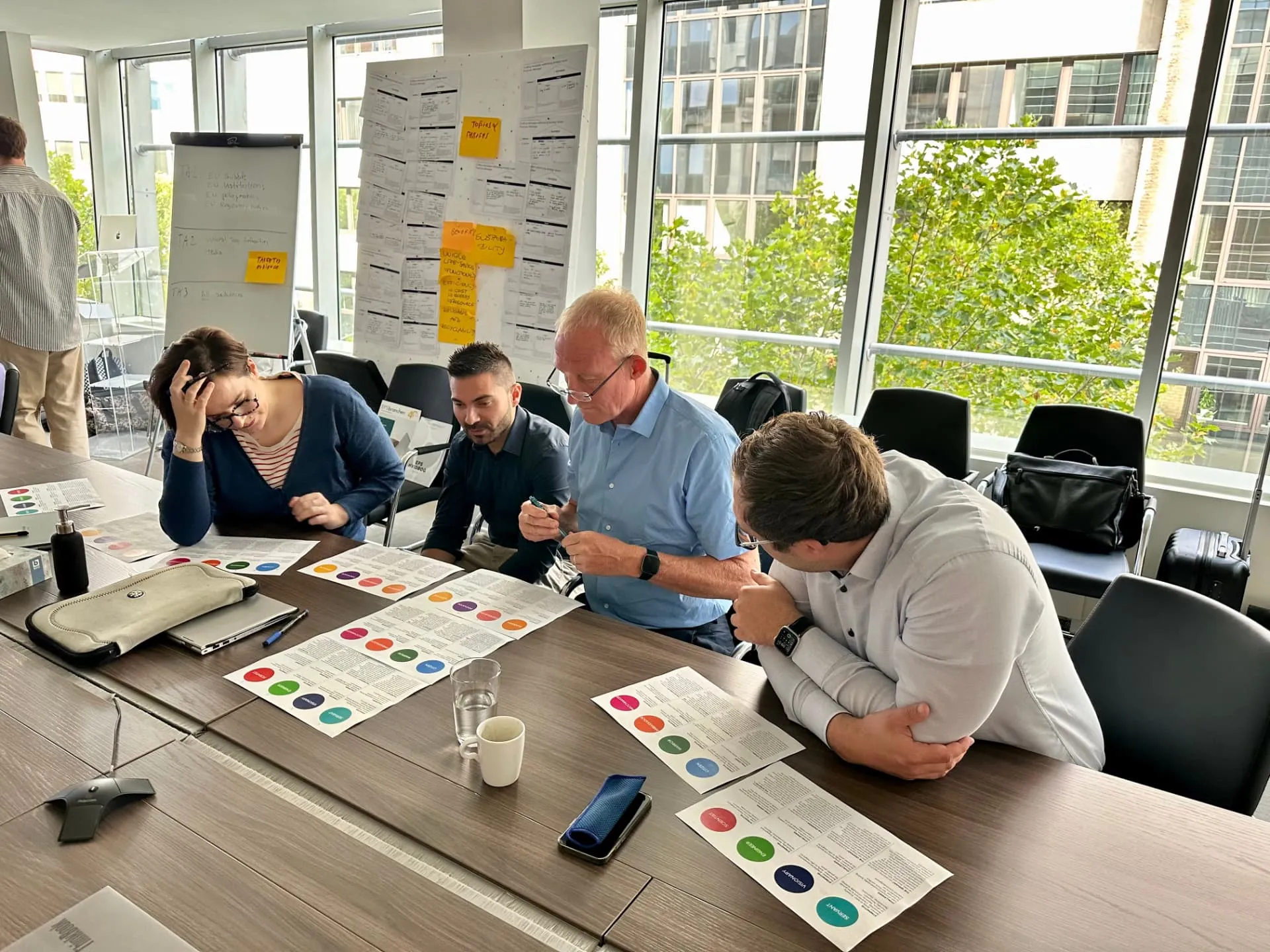
Assess the organisation's ability to use collective work
An organisation can hold many workshops while relying on individual experience to prepare them and recover their findings. Another may use workshops selectively, with clear questions, appropriate participation and a reliable way of taking the work forward. The difference concerns organisational practice as well as facilitation skill.
The Workshop Capability Model brings the publication's argument together in six dimensions and four descriptive stages. It is an editorial framework developed for this publication. It helps a team examine its practice and identify improvements; it has not been statistically validated as a measure of performance or organisational maturity.
The dimensions should be considered together. A clear working question needs suitable evidence. A well prepared group needs an appropriate process. Useful findings need a written account and a route into subsequent work. Learning needs an opportunity for application and a way to preserve experience.
The model can be applied to workshops led internally, with an external partner or through a combination of both. It concerns the organisation's ability to commission, prepare, participate in and use the process.
Six dimensions of workshop capability
1 Purpose and scope
The organisation can explain why collective work is useful for the question at hand. It defines what is open to contribution, the expected result and the boundary between the workshop and later decisions or production.
Evidence of this dimension might include a concise briefing, an agreed working question and an explicit description of what the report should help the client do. Scope can be focused while remaining coherent.
2 Evidence and preparation
Existing documentation informs the design. The team distinguishes established information, assumptions and missing perspectives. The agenda is refined with the client, and preparation responsibilities are agreed.
Relevant material reaches the people who need it in a usable form. Activities are prepared for the actual group and its knowledge, roles, language and participation needs.
3 Participation and authority
Participants are selected for their contribution to the question. The organisation understands who brings evidence, experience, implementation responsibility and decision authority. Representation across members or partners is explicit.
People know what they can agree during the session and what requires later consideration. The process gives the necessary perspectives a meaningful opportunity to contribute, including where hierarchy, language or organisational boundaries could otherwise restrict participation.
4 Facilitation and development
The sequence helps the group explore, compare and consolidate material in a way suited to the purpose. Strategic and creative contributions can be examined against the brief. Participants understand how activities relate to the task.
The facilitator can adapt to important findings while maintaining direction. Professional recommendations are identifiable as such. The capture method preserves enough reasoning and qualification to support an accurate report.
5 Reporting and subsequent use
A written report records the findings and their status. It distinguishes information, interpretations, options, recommendations, decisions, open points and agreed actions where relevant.
The report has an intended reader and use. Recommendations can enter the appropriate decision route, creative directions can inform a brief, contribution models can be examined in operation and remaining questions can be pursued by the responsible people.
6 Learning and continuity
Where learning is part of the purpose, participants practise the relevant methods and can find the reference material afterwards. The organisation can examine application when the question and resources justify it.
Briefs, agendas, reports and examples of subsequent use contribute to organisational memory. Experience informs the next workshop's design without making every agenda identical.
Four descriptive stages
Stage | Typical pattern | Useful management priority |
|---|---|---|
1 Informal sessions | Collective work depends on individual initiative. Purpose, authority or the written record may remain implicit. | Establish the working question, expected result and minimum record needed for subsequent use. |
2 Prepared processes | Briefing and preparation are present, but participation, capture or application varies between assignments. | Connect the agenda, contribution roles and report to the same agreed purpose. |
3 Consistent practice | Important workshops use clear framing, appropriate participation and reports that support further work. | Address gaps between teams or projects and examine how findings are applied. |
4 Organisational capability | The organisation uses workshops selectively, preserves learning and can repeat the method across changing questions and people. | Maintain quality, adapt the approach and strengthen the least reliable dimension. |
An organisation may show different patterns across the dimensions. Its preparation can be strong while its reports are rarely used. A creative team may have effective methods that have not yet been made available to other colleagues. A partner campaign may be well aligned while routine projects still lack clear briefs.
Use the model to locate those differences. Ask for examples of actual practice rather than relying on the organisation's preferred description of itself. The aim is to identify the next useful improvement in the way collective work is designed and used.